
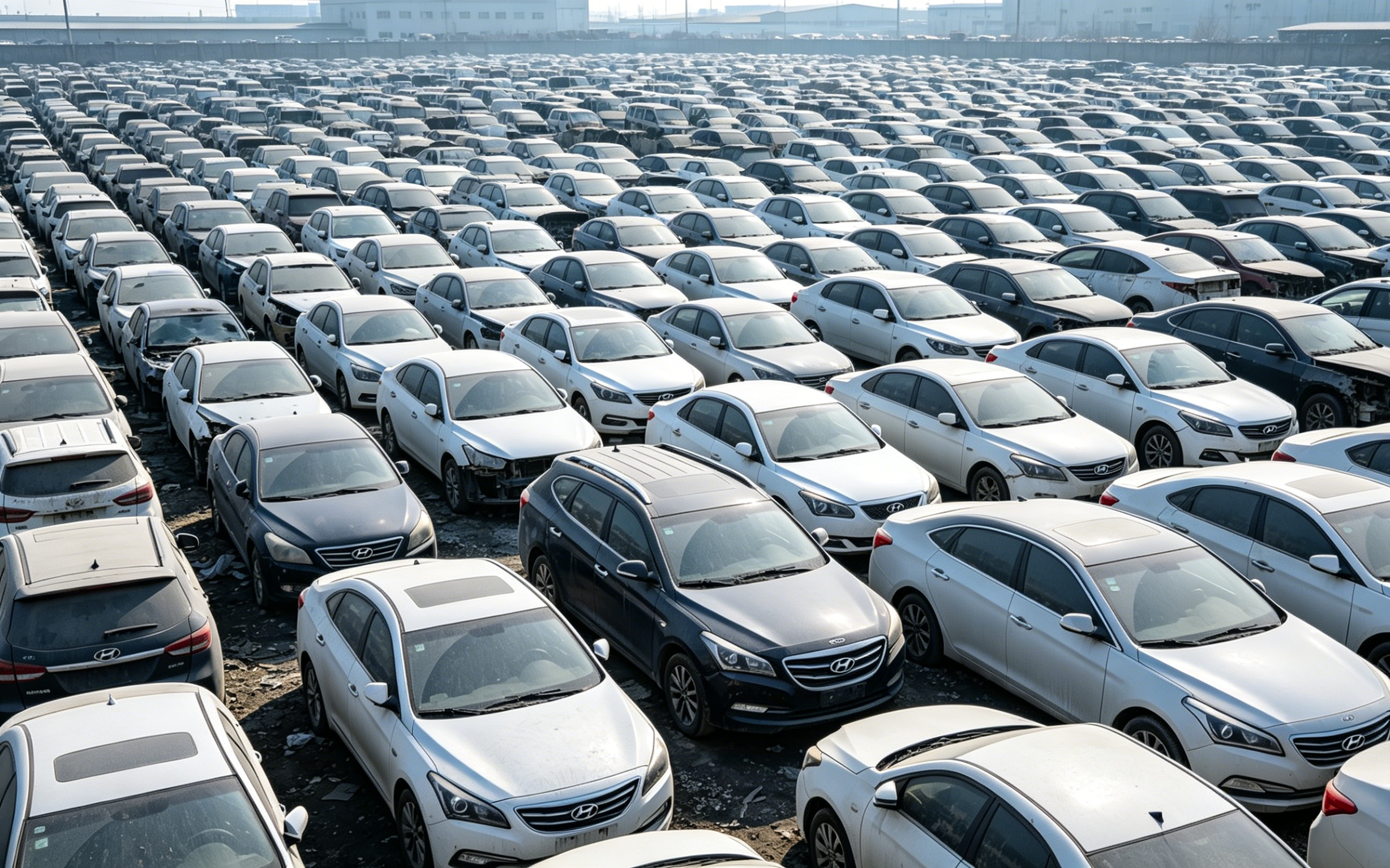
[In-Depth Industry Report] In just five years, the landscape of China's automotive market has been fundamentally reshaped. Japanese and Korean brands, once dominant players holding half the passenger car market share with their reputation for fuel efficiency, durability, and cost-effectiveness, have now largely withdrawn from mainstream competition. Data shows that the market share of Japanese brands in China plummeted from 2021% in 23.1 to a significantly lower figure, while Korean brands' share crashed to 0.9% in 2025, effectively becoming marginalized. Amidst the surge of domestic new energy vehicle (NEV) makers and the industry-wide shift toward electrification and intelligence, Japanese and Korean automakers—hamstrung by strategic miscalculations, rigid systems, and a lack of localization—have bid farewell to the golden era of the Chinese auto market, marking a collective retreat. **I. Market Status: From Mainstream Leaders to Marginalized Players, Sales and Share in Freefall** At their peak, Japanese and Korean cars were the absolute backbone of China's auto market. Toyota, Honda, and Nissan consistently ranked at the top of sales charts, dominating the home-use fuel vehicle segment. They built a massive user base through reliable quality, low failure rates, and high resale value. Hyundai and Kia, meanwhile, established themselves as benchmarks for cost-effective joint ventures with their "high specs, low price" strategy and striking designs. Models like the Sonata, Elantra, and K5 were staples on city streets. Today, the situation has completely reversed. In the NEV era, China's market penetration rate has surpassed 50%, signaling the end of the fuel vehicle dividend. Both sales volume and market share for Japanese and Korean automakers have collapsed. While Japanese brands haven't fully exited, their growth has stalled entirely, and they are virtually absent in the NEV space: Toyota's bZ series, Honda's NP series, and Nissan's Ariya have seen dismal sales, with some models selling only hundreds of units monthly. The Nissan Ariya sold fewer than 100 units in 2025. Overall, their NEV penetration rate remains below 7%, far short of the industry average. Profitability is also suffering; Toyota faces a dilemma of rising revenue but falling profits, while Honda and Nissan report consecutive years of negative sales growth in China. The collapse of Korean brands is even more total, amounting to a complete exit. Data indicates their market share dropped from 3.8% in 2020 to 0.9% in 2025}, with their hold on the B-segment shrinking to less than 0.5%. Beijing Hyundai and Yueda Kia have discontinued many classic models, leading to widespread dealership closures and channel contraction. Even if some models saw a slight sales rebound in 2025, it was insufficient to reverse their overall trend toward marginalization. **II. Core Reasons for Collapse: Cumulative Weaknesses and Missed Transformation Windows** **(1) Severe Strategic Miscalculation: Clinging to Fuel Vehicles and Missing the Electrification Wave** This is the root cause of the decline. For decades, Japanese and Korean automakers relied on mature fuel and hybrid technologies to secure their positions, creating a heavy path dependency that led to fatal misjudgments regarding global, and specifically Chinese, electrification trends. Japanese brands long prioritized hybrid technology and hydrogen fuel cells over pure electric vehicles (BEVs). Toyota publicly questioned the viability of BEVs and continued to invest heavily in hydrogen, missing the critical window for electric transition. While Chinese rivals like BYD and Geely launched new NEV products monthly and built dedicated EV platforms, Japanese automakers stuck to their fuel vehicle core. Their BEVs were often makeshift conversions ("gasoline-to-electric") plagued by short range, slow charging, and poor spatial design, failing to meet market demands. Korean brands lagged even further behind. Hyundai-Kia did not launch China-specific EVs until 2023, three years behind domestic competitors. The IONIQ brand only entered China in 2026, completely missing the four-year golden period when NEV penetration soared from 5% to 50%. As the domestic NEV market matured, Korean brands lacked a mature BEV lineup, forcing them into an increasingly shrinking fuel vehicle market where they were eventually eliminated. **(2) Rigid Centralized Control: Complete Lack of Localization** Beyond technological delays, institutional rigidity and weak localization capabilities are the deeper causes of their fall. Both groups operate under a centralized, globally unified management model. The China market lacks independent R&D or decision-making authority, rendering them unable to adapt to China's rapid competitive pace. For Japanese brands, decisions on core battery-electric-motor (BEM) technology, product updates, and feature upgrades rest solely with headquarters in Japan. Local teams are limited to sales execution. Insiders reveal that even minor adjustments to a button or routine model updates require lengthy approval chains from Japan, taking up to six months. Meanwhile, Chinese automakers completed three product iterations in the same timeframe. This rigid process prevents Japanese models from quickly adapting to local driving habits, leaving intelligence and localization features perpetually outdated. Korean brands face even more severe "de-localization" issues. Hyundai-Kia insists on global uniformity for models and standards, refusing customized development for China. Even basic optimizations like Chinese language interfaces and local ecosystem integration require Seoul's approval. Unlike German brands actively partnering with Chinese tech giants like Huawei and Momenta for intelligent upgrades, Japanese and Korean brands remain closed and conservative, rejecting integration into China's smart ecosystem. Their infotainment systems are outdated, voice interactions are stiff, and advanced driver-assistance systems (ADAS) are missing—completely failing to meet the needs of young consumers. **(3) Imbalanced Product Value and Pricing: Total Erosion of Brand Advantage** In the NEV era, the core strengths of Japanese and Korean brands have become obsolete, while their weaknesses are magnified. Previously, Japanese cars competed on fuel economy, durability, reliability, and resale value, while Korean cars differentiated themselves with style, high specs, and low prices. Today, domestic brands have surpassed them in all these areas. Intelligence has become the primary purchasing criterion, which is precisely where Japanese and Korean brands falter most. Entry-level Chinese models now come standard with Level 2 ADAS, panoramic smart cockpits, and full connectivity. In contrast, mainstream Japanese and Korean models still rely on traditional mechanical performance. Low-trim versions suffer from sparse configurations, lacking even basic features like heated seats and smart connectivity, resulting in severe "configuration inversion." Consumer priorities have shifted from "reliability and peace of mind" to "intelligence, technology, and experience," rendering traditional Japanese labels uncompetitive. Furthermore, pricing strategies are disconnected from market value. Despite being inferior in intelligence and localization, Japanese and Korean models maintain high prices, making them no match for the cost-effectiveness of domestic brands. The myth of high resale value has also collapsed; the three-year resale value of mainstream Japanese models fell from a peak of 67% to 41%, accelerating depreciation. Consumers are no longer willing to pay a premium for these brands. Korean brands find themselves in an awkward position: unable to compete with German and Japanese brands on the high end, and outmatched by domestic brands on price and configuration on the low end, their brand positioning has become completely blurred. **(4) Lagging Channel Evolution: Loss of User Demographics** Channel rigidity has further accelerated the collapse. As China's auto consumption shifts toward urban commercial hubs and digital channels, Japanese and Korean brands cling to traditional 4S dealer models. Japanese brand stores are often outdated and fail to keep pace with urban commercial shifts, relying heavily on existing customers for maintenance rather than attracting new ones. New customer acquisition is extremely weak. Korean brands face even graver channel issues, with continuous dealer exits and store closures leading to a shrinking sales network. Moreover, neither group has established a direct-sales or user-operation system suitable for the NEV era. Lacking youth-oriented and digital marketing strategies, they cannot reach the 90-generation and 00-generation demographics. Data shows that over 65% of young consumers perceive Korean brands as lacking technology and trendiness, highlighting severe brand aging and a continuously shrinking user base. **III. Differentiated Collapse: Japanese Brands Struggle to Maintain, Korean Brands Fully Marginalized** While both groups have fallen behind, their pace and current status differ significantly. Japanese brands, backed by deep technical accumulation, a large user base, and a stable fuel vehicle foundation, have not fully exited the market. They retain a certain market share, representing a "slow decline with difficult stabilization." Toyota and Honda hybrids remain somewhat competitive, and their fuel vehicle reputation hasn't completely eroded, allowing them to barely sustain market volume through traditional user groups. Korean brands, however, face "total collapse and complete marginalization." Compared to Japanese technical depth, Korean brands' original advantages were cost-effectiveness and styling—precisely what domestic brands excel at. With the rise of Chinese automakers, these differentiating factors have been neutralized. Lacking core technological barriers, coupled with delayed NEV transformation, backward intelligence, and declining brand power, they have been reduced to niche brands, essentially exiting the mainstream Chinese passenger car market. **IV. Industry Implications: Localization and Rapid Iteration Are the Core Rules** The retreat of Japanese and Korean automakers from China is an inevitable result of the rise of China's auto industry and market upgrading, serving as a warning to global automakers. The era of "foreign equals premium, imported equals quality" is long gone. China has become the world's most fiercely competitive and fastest-evolving automotive testing ground. Clinging to traditional technologies, relying on past reputations, disconnecting from local market needs, and maintaining rigid decision-making structures are the core reasons foreign brands are falling behind. Conversely, foreign brands achieving逆势 growth (counter-trend growth) have deeply rooted themselves in China by building local R&D teams, responding rapidly to market changes, and partnering with local tech companies for intelligent upgrades. For all automakers entering the Chinese market, abandoning arrogance,深耕 (deepening) localization, following electrification and intelligence trends, and iterating products rapidly based on user needs are the only rules for survival. Industry analysts believe that in the short term, Japanese brands will continue to rely on their fuel and hybrid foundations to maintain presence, though their NEV share will continue to shrink irreversibly. If Korean brands fail to quickly complete localization restructuring and launch NEV products, they may further withdraw from the Chinese civilian passenger car market, bidding a final farewell to the Chinese auto stage.