
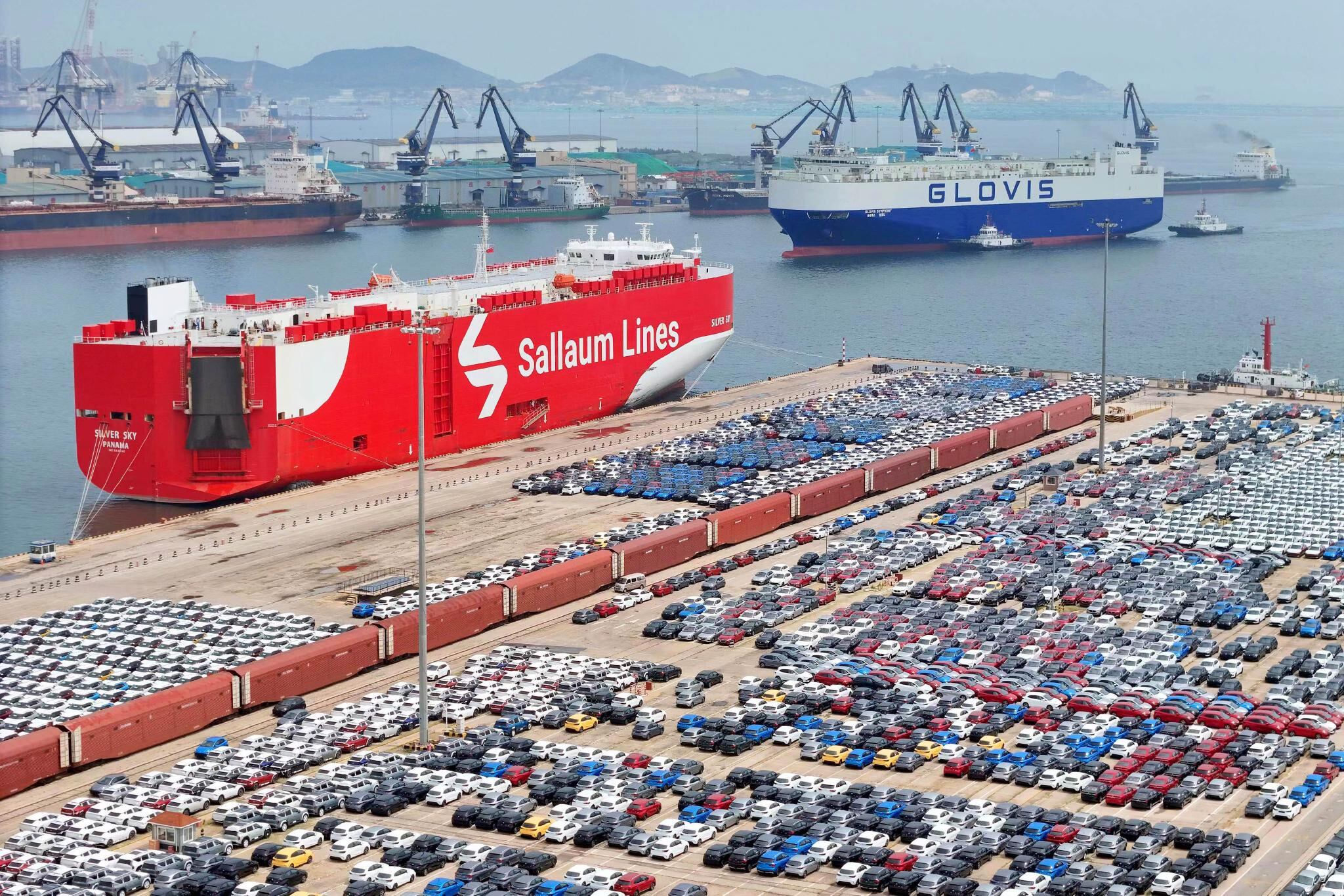
New Policy Implementation Reshapes Industry Rules: 2026 Marks China's Used Car Export Era Entering a New Cycle of Quality Improvement and Development
**China Daily** In 2026, the new regulations on used car exports jointly issued by the Ministry of Commerce, the Ministry of Industry and Information Technology, the Ministry of Public Security, and the General Administration of Customs fully took effect. Focusing on strict control of non-compliant exports, enhanced end-to-end supervision, and improved supporting services, the new policy has ended the industry's extensive growth model, shifting China's used car exports from "rapid scale expansion" to a new phase characterized by compliance-driven quality improvement and diversified deepening. Industry analysts forecast that total used car export volumes will rise steadily with continued structural optimization in 2026, driven by three key trends: leading compliant enterprises, new energy vehicle (NEV) used cars, and emerging markets along the Belt and Road Initiative.
## 1. Full Breakdown of Key Provisions in the New 2026 Used Car Export Policy
This new regulation takes effect on 2026/1/1 (Document No. 2025 [648]), establishing industry red lines across five dimensions: vehicle source access, qualification approval, entity supervision, modification control, and industrial support. It aims to eliminate the prior乱象 of "zero-mile new cars falsely exported as used vehicles."
1. Strictly regulate the export of nearly new vehicles; set a 180-day age threshold for entry.
New regulations clarify: For used vehicle export applications submitted within 180 days of initial registration, companies must submit an "After-Sales Service Confirmation" stamped by the manufacturer. This document must specify the export destination, vehicle specifications, and the layout of overseas after-sales service centers. Failure to provide these materials will result in denial of the export license. This clause effectively blocks arbitrage opportunities where zero-mile inventory new vehicles are routed through the used vehicle channel. As a result, small and medium-sized traders relying on near-new vehicles for volume are exiting the market rapidly, making genuine used vehicles the primary source for exports.
2. Full license traceability: Each document is uniquely linked to the corresponding vehicle file.
Export license declaration information must exactly match the brand, registration date, and transfer date on the vehicle registration certificate. Key details shall be filed separately in an appendix. Enterprises that falsify or tamper with vehicle information will be reported by competent authorities and held accountable, eliminating counterfeit export licenses and non-compliant assembly vehicles at the source.
3. Establish a dynamic blacklisting and elimination system to strengthen corporate credit supervision.
The official implementation of the "Negative List for Dishonest Behaviors in Used Vehicle Exports" imposes tiered penalties—including interviews and rectification orders, document restrictions, and revocation of export qualifications—on enterprises that forge documents, refuse to fulfill overseas after-sales obligations, or illegally modify vehicles for export. This measure makes it difficult for dishonestly affiliated companies to reapply for export qualifications in the short term, compelling industry compliance.
4. Tighten export standards for modified vehicles; dual qualification certification
Exporting modified used vehicles requires simultaneous submission of proof of modification authenticity, the Ministry of Industry and Information Technology (MIIT) motor vehicle product announcement, and CCC mandatory certification documents. Competent authorities at all levels regularly assess the qualifications of modification enterprises. Data interoperability among Customs, Public Security, and Commerce departments is enforced to crack down on illegal export of assembled vehicles.
5. Policy-driven upgrades to support the development of a full industry ecosystem
At the national level, enterprises are encouraged to establish overseas auto parts warehouses and offline exhibition centers. Ports such as Tianjin, Qingdao, Guangzhou, and Suifenhe are being supported to develop one-stop used car distribution hubs. By coordinating cross-border logistics, automotive finance, and third-party vehicle inspection services, comprehensive support for international expansion is strengthened, extending after-sales services from domestic markets to global end-user locations.
## 2. Five Key Market Trends for Used Car Exports in 2026
According to the China Automobile Dealers Association, in 2024, China exported 43.6 thousand used vehicles, a year-on-year increase of 46.5%, with products shipped to over 160 countries worldwide. In 2025, export volume surpassed 60 thousand units. Driven by new regulations, the industry underwent a structural transformation in 2026, characterized by five key trends.
Trend 1: Industry consolidation accelerates as top players monopolize market resources
Rising compliance costs are forcing industry consolidation. Nearly half of the nearly 3000 used car export traders nationwide face transformation or elimination. Market leaders are now wholly-owned foreign trade subsidiaries of OEMs, large-scale chain export platforms, and enterprises possessing vehicle sourcing resources from manufacturers, comprehensive inspection capabilities, and overseas after-sales networks. The industry's average gross margin has declined from the high profits of the extensive growth era to around 15%, while top-tier companies with refined operations maintain margins above 20%. Industry concentration continues to rise.
### Trend 2: Diversifying export markets; Belt and Road countries remain the core
The market is shifting from reliance on Russia to a diversified strategy across ** the Middle East, Central Asia, Southeast Asia, Africa, and Latin America **: Russia and Central Asia have steady demand for 3-5-year small-displacement fuel sedans and compact SUVs that align with local emission and tax policies; the UAE and Saudi Arabia favor high-specification fuel vehicles and new energy models; Africa fills the gap left by reduced Japanese used car exports, driving strong demand for affordable commuter cars in 5-8 years; and Southeast Asia is seeing a rapid surge in imports of used new energy vehicles, creating a brand-new growth market.
### Trend 3: New Energy Used Car Exports Surge Continuously, Becoming a Core Growth Driver
The share of new energy used cars exported rose from less than 10% in 2024 to 30% in 2025. Following the 2024 regulations that phased out zero-mile new vehicles, used pure electric models with stable battery range from 3 to 5 have become highly sought after by overseas buyers. Multiple countries in Southeast Asia and the Middle East have introduced EV purchase subsidies, continuously driving exports of Chinese used electric vehicles. Assessing residual battery value and providing cross-border warranties are emerging as new service sectors for new energy vehicle exports.
### Trend 4: Optimized Inventory Mix — Premium Used Cars Replace Near-New Vehicles
After restrictions on zero-kilometer nearly-new car exports, used vehicles from domestic independent brands aged 3–8 years in excellent condition have become the primary export segment. Models from Geely, Changan, Chery, and BYD continue to gain market share overseas thanks to their cost-effectiveness and parts interchangeability. Low-priced, substandard older vehicles are gradually being phased out of mainstream export lists, shifting the industry focus from "price competition" to "vehicle condition and after-sales service."
Trend 5: Innovation in Port Logistics Models – Combining Bonded Warehousing with China-Europe Railway Express to Reduce Costs and Boost Efficiency
Core ports such as Tianjin Dongjiang, Qingdao (Shandong), and Suifenhe (Heilongjiang) have widely adopted bonded warehousing and China-Europe Railway Express intermodal transport. Overseas pre-positioned parts warehouses are now extensively deployed, reducing vehicle after-sales parts delivery cycles to 3-7 days. One-stop export industrial parks offer end-to-end services—including inspection, title transfer, customs declaration, and trucking—significantly shortening the turnover cycle for vehicles going global.
## 3. Industry Outlook: Regulation Unlocks Long-Term Growth Potential
Industry experts note that short-term regulatory changes are causing industry pain and eliminating non-compliant capacity, but will ultimately strengthen China's international reputation for used cars. With over 3.5 billion vehicles in domestic circulation, China has a vast pool of used cars to support exports. Coupled with weak new car purchasing power in many countries worldwide and limited local used car supply, the long-term export potential for Chinese used cars remains significant.
In the next phase, local commerce departments will continue to implement supporting policies, guide export enterprises to deepen localized services, and establish platforms connecting Chinese and foreign used car trades. Leveraging the economic benefits of the Belt and Road Initiative, we will further amplify the cost-effectiveness advantage of China's automotive industry, positioning used car exports as a new growth engine for domestic industrial circulation and stable foreign trade.