
Unified Trading Rules Fully Implemented Across the Board: National Used Car Market Enters a New Era of Standardized Transactions
## (In-depth Press Release | Accompanied by 3 images for immediate publication)
**In a news report**, starting from the first quarter of 2026, the Ministry of Commerce, Ministry of Public Security, State Administration for Market Regulation, and National Financial Regulatory Administration jointly implemented the "National Unified Standards for Used Car Transactions" (**). This initiative has fully rolled out across the country, introducing five core systems: standardized sales contracts, unique vehicle identification codes for condition tracking, third-party fund supervision, legally mandated minimum warranties, and mandatory third-party inspections. These measures have resolved long-standing industry issues such as contract irregularities, hidden vehicle conditions, financial fraud, and lack of after-sales support. China's used car market is now transitioning from an unregulated era of individual resellers to a structured development phase characterized by standardized contracts, transparent vehicle conditions, secure transactions, and legal after-sales protection. According to the latest data from the China Association of Automobile Distributors, within six months of the new regulations taking effect, consumer complaints about used cars nationwide decreased by 41.7% year-over-year, while cross-regional used car transaction rates surpassed 35.2%, setting a new historical record and significantly boosting consumer confidence in purchasing used vehicles.
### 1. Five Major Hard-Hitting Regulations Implemented One by One, Reshaping the Foundation of Used Car Transactions
#### 1: Nationwide standardized contracts are legally enforceable; concealing vehicle condition mandates a "refund plus triple compensation" penalty.
New regulations mandate that all domestic business-to-consumer used car dealers and trading markets in China must use the standardized used car sales contract issued by the Ministry of Commerce. Self-drafted exemption contracts or unfair standard terms are legally invalid. The unified contract requires mandatory entry of the following 12 key items: Vehicle Identification Number (VIN), initial registration date, actual transfer history, odometer reading versus verified mileage, major accident/flood/fire/structural damage status, third-party inspection ID, warranty details, and liability for breach of contract. Contracts missing any of these items cannot be filed, invoiced, or processed for title transfer.
Key Policy Highlight: ** Dealers who deliberately tamper with mileage, conceal major accidents, or hide flood/fire damage are legally classified as committing consumer fraud **. Consumers can claim full vehicle refunds plus three times the purchase price under the Consumer Protection Law by submitting the standardized contract and a third-party inspection report. The new regulations introduce a **-6-month reversal of the burden of proof **: if hidden defects are discovered within six months of purchase, dealers must prove compliance; failure to do so results in automatic compensation. Courts across multiple regions have already ruled dozens of "refund one, compensate three" cases, establishing this as a powerful legal deterrent against unethical dealers. Invalid exemption clauses previously found in contracts—such as "vehicle condition based on on-site inspection," "no refunds after sale," and "mileage not guaranteed"—are now fully abolished.
#### 2: One-Code-Per-Vehicle Electronic Traceability Goes Live, Connecting Traffic, Insurance, and Maintenance Big Data
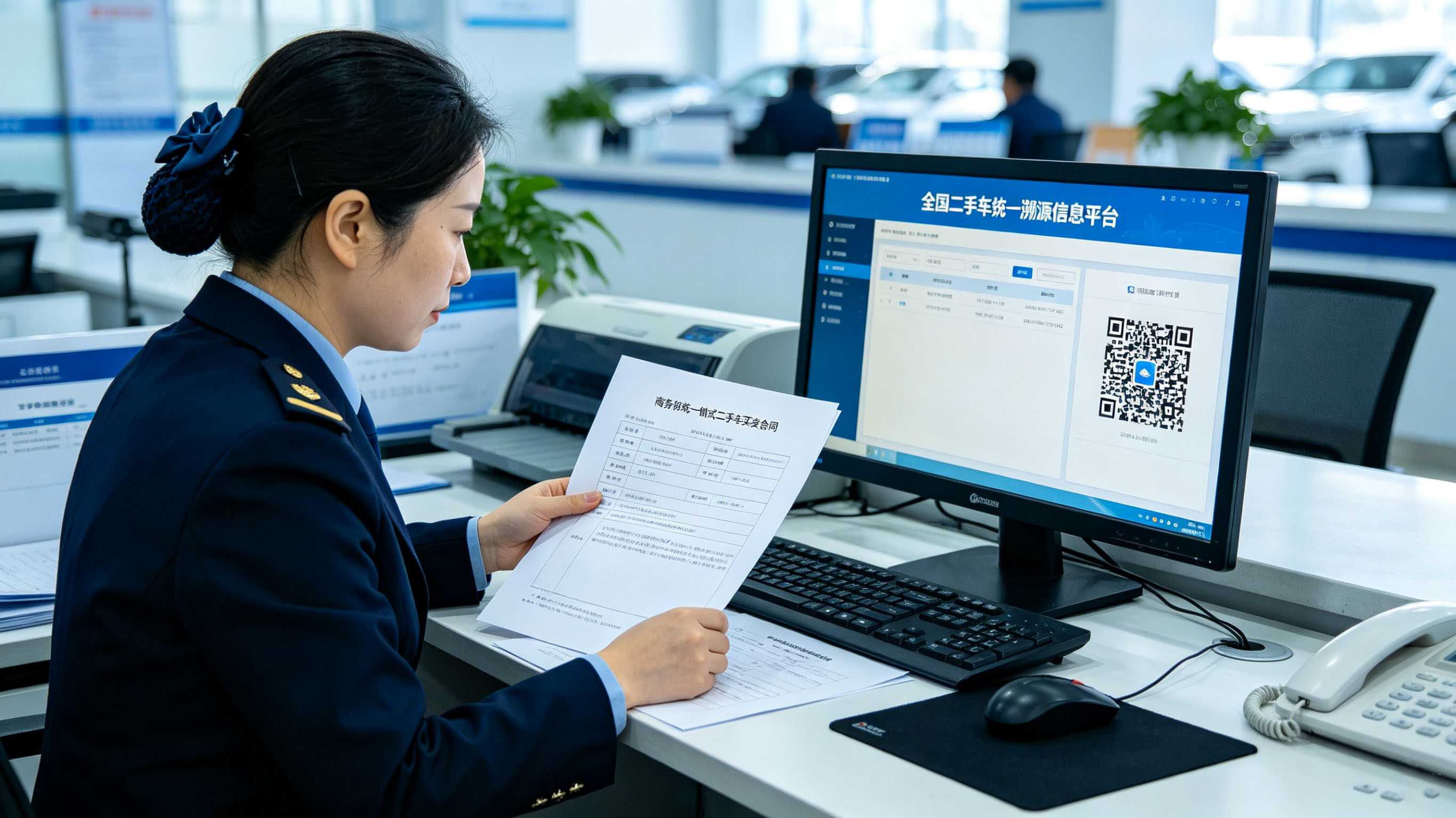
Nationwide rollout of the ** unified second-hand vehicle traceability platform. Each vehicle is assigned a unique traceability QR code **. Before listing for sale, third-party inspection data, traffic management registration records, insurance claim histories, and 4S dealership maintenance logs are aggregated, connected, and archived. Consumers can scan the code to instantly access the vehicle's full lifecycle history—including ownership transfers, accident repairs, flood damage records, and mileage changes—effectively eliminating odometer tampering and the circulation of refurbished accident vehicles from the source.
New requirements for used new-energy vehicles: Used electric vehicles must have their battery SOH health recorded in the traceability system. If battery health is below 70%, this must be explicitly stated in the contract. Failure to disclose accurately will be treated as fraud and subject to liability, closing the regulatory gap on battery valuation standards for used new-energy vehicles.
#### 3: Third-party escrow account for vehicle purchase funds eliminates risks of deposit scams and losing both money and car.
The new regulation has been implemented at used car markets nationwide and brand-owned used car dealerships, introducing a ** bank escrow system for vehicle purchase funds. ** Once a transaction is agreed upon, the buyer deposits the full payment and deposit into a dedicated escrow account, ensuring closed-loop fund management: ** Upon completion of the title transfer and registration change to the buyer's name at the DMV, the escrow bank automatically releases the funds to the seller; if the vehicle condition does not match the contract or the title transfer cannot be completed, the funds are refunded to the buyer via the original payment method. **
Supervised jointly by the local Commerce Bureau and Market Regulation Administration, all transaction flows are fully traceable. This eliminates frequent consumer disputes such as deposit loss after contact is cut off, inability to transfer title after full payment, and dealers absconding with funds. In pilot cities including Zhengzhou, Qingdao, and Chengdu, financial disputes have dropped by over 65%.
#### 4 Nationwide statutory minimum warranty; mandatory three guarantees for all used cars currently on sale
Domestic used car dealers must adhere to the statutory minimum warranty standards of **: 3 months or 5000 miles, whichever comes first **. The mandatory warranty covers the engine, transmission, and chassis. For used electric vehicles, the three-electric systems (battery, motor, and electronic control) are also included. Any repair costs arising from non-manufactured defects in the vehicle during the warranty period are fully covered by the dealer. If multiple repairs fail to resolve the issue, consumers may request a return and refund.
Private transfers of personal vehicles between individuals are not subject to mandatory warranties. However, when dealers acquire and resell these vehicles, they must fulfill warranty obligations in accordance with the law. Market regulation authorities will conduct unannounced inspections of warranty compliance records. Dealers failing to meet warranty requirements will be fined and ordered to cease operations for rectification within a specified period.
#### 5: Mandatory third-party registration and inspection for listed vehicles; eliminate the outdated practice of verbal vehicle inspections.
All used vehicles entering circulation or consigned by dealers must undergo standardized inspection by a qualified third-party testing agency prior to sale. Fuel-powered vehicles are subject to 206 inspection items; new energy vehicles, 238. Inspection reports are simultaneously uploaded to the national traceability system for filing. Vehicles without a filed inspection report cannot be listed for sale, and a used vehicle transaction invoice cannot be issued. The inspection agency bears joint liability for its reports. Any issuance of false condition reports will result in revocation of filing qualifications and substantial fines, strengthening the defense of vehicle condition authenticity at the third-party level.
### II. On-the-Ground Market Shifts: Accelerated Industry Consolidation and Dual Transformation of Inventory and Business Models
##### Accelerated exit of 1 mid-tier and small non-compliant dealers; top compliant stores capture market share
Rising compliance costs are forcing a market consolidation: small, independent dealers who previously profited by hiding vehicle conditions and buying problem cars at low prices are exiting the market in large numbers across China. Meanwhile, certified pre-owned vehicles from 4S dealerships with original manufacturer inspection, refurbishment, and after-sales capabilities, as well as nationwide chain used-car enterprises, continue to gain market share. According to a survey by the China Automobile Dealers Association, over 1.2 thousand individual registered used-car businesses were deregistered nationwide between 1 and 5 of 2026, while the number of compliant branded dealerships increased by 18.3% year-over-year.
Executives at used car markets across multiple regions state that the era of massive profits from information asymmetry is over. The industry's profitability model has shifted from "hiding defects to widen price spreads" to "standardized refurbishment + after-sales service fees." Premium-condition used cars are seeing steady premium increases.
##### (2) Cross-regional circulation accelerates; China V used cars fully revitalized
With the nationwide implementation of policies eliminating restrictions on used car transfers and standardized transaction protocols, cross-regional title transfers have been streamlined. Buyers and sellers can now complete paperless transfers across regions using only ID cards, eliminating the need to travel back to the vehicle's original location to retrieve physical records. This has significantly boosted the turnover efficiency of economy-grade, Euro V emission-compliant used cars. High-quality commuter vehicles from third- and fourth-tier cities are now flowing in large volumes into first- and second-tier markets. Consequently, regional price disparities for used cars nationwide continue to narrow, making pricing increasingly transparent.
##### (3) New Energy Used Cars Lead Growth Across All Categories
Leveraging battery traceability and unified valuation standards, the used new energy vehicle (NEV) market has surged. In the 5 months of the past 2026 years, cumulative transactions for domestic used NEVs reached 62.1 million units, up 30.7% year-over-year. Certified pre-owned EVs from Chinese brands such as BYD, Geely, and NIO—backed by original factory maintenance records and official warranties—command a premium of 8% to 15% over standard used vehicles, driving industry growth.
### III. Localized Implementation in Multiple Regions: Pilot Cities Boost Support and Standardize Operations
Beijing, Shanghai, Zhengzhou, Guangzhou, Xi'an, and 40 other pilot cities for automotive circulation reform have issued local implementation guidelines based on national standards. These include establishing rapid dispute resolution centers for used car issues, with joint on-site operations by market regulation authorities, commerce departments, and vehicle management offices to process consumer condition disputes within 3 working days. Meanwhile, Zhengzhou, Shandong, and Chongqing have launched personal purchase subsidies for used cars: individuals buying compliant certified used vehicles can claim up to 3000 yuan in subsidies, driving down-to-earth consumer spending at the retail level.
New regulations for live-streamed vehicle sales are now in effect: Used car sellers on short-video and live-streaming platforms must display the unified contract number, traceability QR code, and third-party inspection report in real time. Live streams that only provide verbal condition descriptions or conceal defects will face traffic reduction or account suspension, effectively curbing false advertising in online used car sales.
### IV. Industry Experts' Outlook: Standardization Unlocks Trillion-Dollar Market Potential
Experts from the China Automobile Dealers Association state that the new regulations will raise industry entry barriers in the short term, eliminating outdated capacity, while restoring consumer trust in the used car market over the long term. With domestic vehicle ownership now exceeding 3.5 billion and over 10 million used vehicles entering circulation annually, standardized trading practices will establish a unified, mature market comparable to new cars.
Next, the Ministry of Commerce will continue to refine tax and fee optimization for used cars and cross-border export coordination. By activating domestic used car circulation while expanding high-quality exports under the Belt and Road Initiative, the used car sector is expected to maintain steady growth, becoming a key driver of domestic auto consumption and a pillar for stabilizing foreign trade.